
Estonia's international reputation as a digital leader with outstanding and long-term experience sets high expectations for us, but such a reputation will quickly disappear if Estonia does not lead the next breakthrough in digital state governance. A forward-looking Estonia has a unique opportunity to be a global leader in the adoption of AI solutions, including in the debate on data management and the ethical, democratic, and secure application of AI in the immediate region, the European Union, and globally. Estonia can also offer the best ecosystem (including the legal framework) for researching and testing data-driven future technologies and business models. Moreover, we are key partners for our closest allies, such as Ukraine, in developing the public sector, cybersecurity, and digital capabilities.
The goal of developing the digital state and AI is to provide more value to the taxpayer without raising taxes and costs. Just as companies use technology to offer better products and services with fewer employees, AI also helps the state operate faster, more securely, and with higher quality, but with a reduced administrative burden. The working-age population in Estonia is decreasing, and therefore it is especially important that people in the public sector have time to do work that requires human decisions and input, while routine and supportive tasks are automated. Investing in the digital state thus means saving on other costs and a better-functioning state for everyone.
The Estonian Digital Agenda 2035 is a guideline for developing and managing Estonia's digital society in an era of technological breakthroughs and geopolitical and economic challenges. It is an important cooperation framework for various state and private sector institutions and enables the setting of priorities under conditions of limited resources.
It is clear that the exact planning of development trends for the next ten years in a rapidly changing technology world is practically impossible. Therefore, we consider the agenda a living document that evolves over time and adapts to changes, and its timeliness and relevance are assessed at least once a year.
The agenda supports the goals of the national strategy "Estonia 2035", primarily by enhancing state governance, promoting economic competitiveness, and ensuring the functioning of the digital state in any situation.
Estonian digital society in 2035
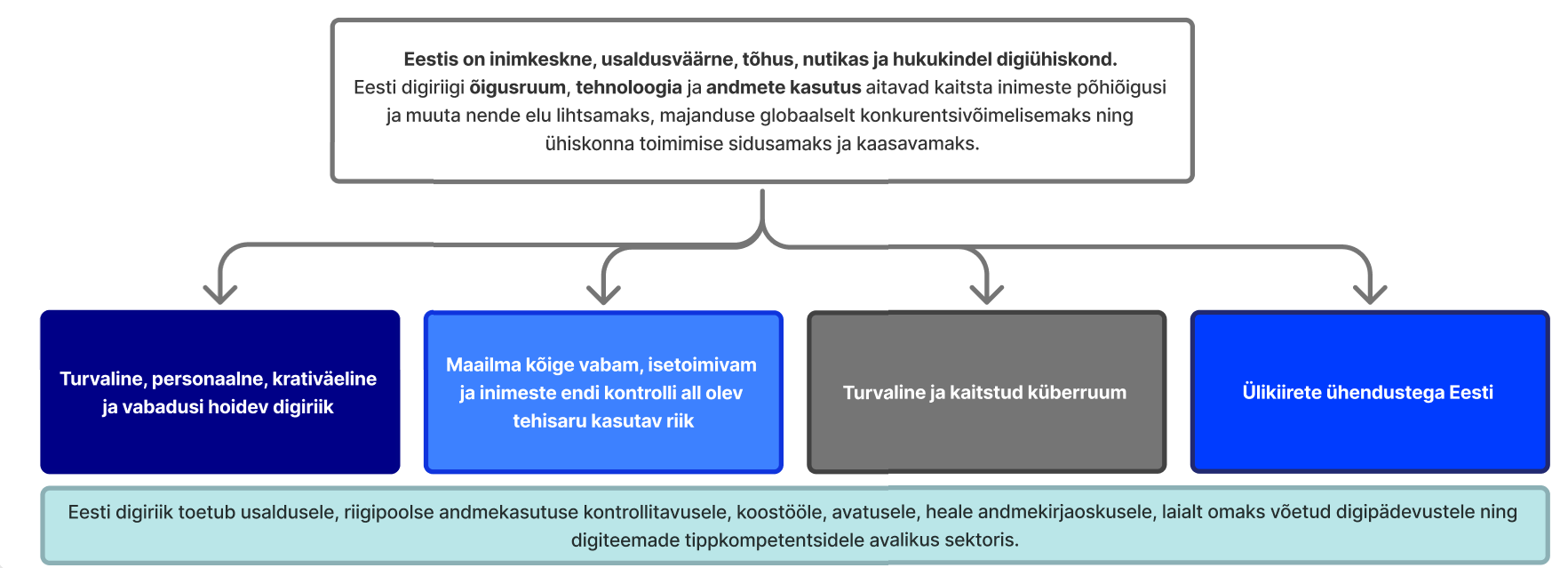
Goals of the agenda
Goal 1. A secure, personalized, AI-empowered, and freedom-preserving digital state
A secure, personalized, AI-empowered, and freedom-preserving digital state In the Estonian digital state, public services are secure, personalized, proactive to the extent permitted by the individual, and event-based, i.e., AI-empowered. The organization of the services themselves is pragmatic and sensible, based on efficient data management, ICT governance is centrally coordinated, and the infrastructure is legally robust. For this, it is important to ensure a clear and freedom-preserving legal framework, data reusability, continuous updating and modernizing of the population's digital competencies, strong experts, and their next generation across all sectors.
Expected results:
Public services are user-centric, accessible, proactive, and holistic from the perspective of users' life or business events, extending across agency, sector, and country borders. Services reach the person at the right time, in a suitable way and format, and with minimal administrative burden.
Digital state services are reliable, secure, fast, and cost-effective, reducing the need for labor in the public sector, ensuring that the concerns of residents, entrepreneurs, and the state are resolved without delay, quickly and efficiently, and ensuring the continuity of services in any situation.
The development of the digital state is strategically managed and coordinated, and its costs and results are measurable, ensuring the efficient use of public funds and the long-term sustainability and development capacity of the digital state.
The development of digital and cyber skills, including data literacy and the ability to use AI, is a continuous, comprehensive, and systematic process covering the entire educational path, the public sector, and the working-age population, supporting the development of the digital state.
Future scenario "Zero bureaucracy"
Year 2035. Developer Epp informs her European eID assistant: "We are moving to Saaremaa with the family." This single sentence triggers an AI-powered service chain based on the authorizations given by Epp, reliable platforms, and strategic management. Epp and her family's data moves securely on the X-Road between local governments and registries; information about school placements arrives in her national mailbox. Since Epp works for a foreign client, international data exchange automatically ensures the correct calculation of her social security and other taxes. Finally, the system notes alongside the school offer that a place has been reserved for her child in the advanced drone and robotics club at the new school, ensuring the continuation of their hobby education if desired.
Goal 2. The freest, most autonomous, and user-controlled AI-using state in the world
In Estonia, data and AI are applied in a human-centric, secure, and smart way across all sectors and walks of life so that the individual has control over their data and its use, and the preservation of the Estonian language and culture over time is ensured. The data management and AI usage of the Estonian digital state are trustworthy and transparent, and there is local infrastructure for the secure processing of data and AI. This positions Estonia globally as a clearly distinct, freedom-preserving, and leading state in developing and applying AI. Estonia has a future-proof data economy.
Expected results:
Estonia applies data and AI in a human-centric, secure, and smart way across all sectors and walks of life, and supports a future-proof data economy.
Estonia is a leading applier of AI in the world; there is local infrastructure for the secure processing of AI and data, as well as AI systems developed locally or co-created with like-minded countries and companies.
AI is used systematically and smartly in every walk of life so that the individual has control over AI and data, as well as their use, and the preservation of the Estonian language and culture over time is ensured.
The data management and AI usage of the Estonian digital state are human-centric, reliable, and transparent. We are a clearly distinguished leader in this regard compared to other countries in the world. A person can always inquire how, for example, a decision made about them using AI was born. The person themselves grants authorizations for AI to use their data – it is also possible to choose more time-consuming service solutions.
Future scenario "Zero bureaucracy"
In 2035, a small business owner uses the data and AI services of the digital state to develop their business activities in real-time. They submit a query to Bürokratt: "I want to export my handcrafted furniture to European Union countries." Bürokratt does not give them links to laws and measures, but generates a personalized action plan: finds suitable sales channels for specific products, evaluates the compliance of their products with requirements, calculates the CO2 footprint of transport in real-time for various logistics partners, and initiates a pre-filled application for an EIS export guarantee. The state has become a real-time strategic partner.
Goal 3. A secure and protected cyberspace
A secure and protected cyberspace Estonia has a secure and trustworthy cyberspace, which is the foundation of our digital society, economy, and statehood. We protect society and the digital state under conditions where the number of high-impact cyber incidents is constantly increasing. In a 5–10 year perspective, Estonia has significantly reduced the impact of critical cyber incidents, including massive data leaks, and limited the ability of geopolitical adversaries to exert covert pressure on vital infrastructure. Despite the continuous development of threat actors, the protection of Estonia's digital services and networks, as well as society's trust in them, has improved. The defense of Estonia's cyberspace is able to adapt to rapid changes and encompasses the whole society, withstanding both geopolitical pressure and the risks arising from the rapid development of technology.
Expected results:
Estonia's cybersecurity is ensured through targeted and coordinated central management.
The entire society is empowered to prevent cyber threats and to respond to them quickly and appropriately.
International cooperation is carried out to shape a secure cyber environment, and the next generation of experts is ensured.
Future scenario "Operation Icebreaker"
An extensive cyberattack is taking place across the world, targeting critical infrastructure services such as energy, financial, and healthcare systems. The attack spreads rapidly from country to country, exploiting existing security vulnerabilities and AI-generated attack vectors. Estonia detects the global threat early thanks to the international network of CERTs and automated threat intelligence exchange. The national cyber command center signals the need for additional protective measures and raises the threat level. The Estonian cyber shield, an automated security layer system, engages immediately and blocks attack vectors. While the global attack causes power outages, stalled payment transfers, and disruptions in the functioning of hospitals elsewhere in the world, services in Estonia remain operational. Patients receive necessary treatment, energy supply remains stable, and payment solutions work normally. Society maintains its normal rhythm of daily life, which increases residents' trust in the state. Estonia's ability to respond skillfully stems from international technical cooperation, well-organized national cybersecurity, and automated defense mechanisms that act before the attack reaches its target.
Goal 4. Estonia with ultra-fast connections
Ultra-fast, reliable, and affordable communication connections are guaranteed in all corners of Estonia. Ultra-fast connections are the bloodstream of the Estonian digital state and economy, necessary for strengthening our competitiveness, creating new business models, and ensuring equal opportunities.
Expected results:
Estonia has a regulatory framework that encourages innovation and investments, taking into account the stable development of the market.
We are accelerating the rollout of very high-capacity access networks and 5G/6G mobile networks to ensure the availability of fast and reliable connections throughout Estonia.
We ensure the continuity and reliability of Estonian communication networks in any situation.
Future scenario "Uninterrupted communication connection"
Year 2035. The Estonian communication network is designed in such a way that the connection is maintained even in critical situations. If a storm damages terrestrial communication lines, it does not disrupt communication services – an autonomous medical drone and the hospital's smart network continue to operate thanks to the 5G network, which can dynamically route traffic and keep critical services running. The smart multi-layered infrastructure ensures that communication continuity no longer depends on individual masts or cables, but on distributed and smart solutions. In an Estonia with ultra-fast connections, a vital communication network is secured by technologies and methods that keep the state functioning even in the most difficult conditions.
Future scenario "Zero bureaucracy"
In 2035, a small business owner uses the data and AI services of the digital state to develop their business activities in real-time. They submit a query to Bürokratt: "I want to export my handcrafted furniture to European Union countries." Bürokratt does not give them links to laws and measures, but generates a personalized action plan: finds suitable sales channels for specific products, evaluates the compliance of their products with requirements, calculates the CO2 footprint of transport in real-time for various logistics partners, and initiates a pre-filled application for an EIS export guarantee. The state has become a real-time strategic partner.
Last updated: 07.10.2026